Commonly Confusing Misspelled Homophones - Your/You're, Its/It's, To/Too, and More

What is a Homophone?
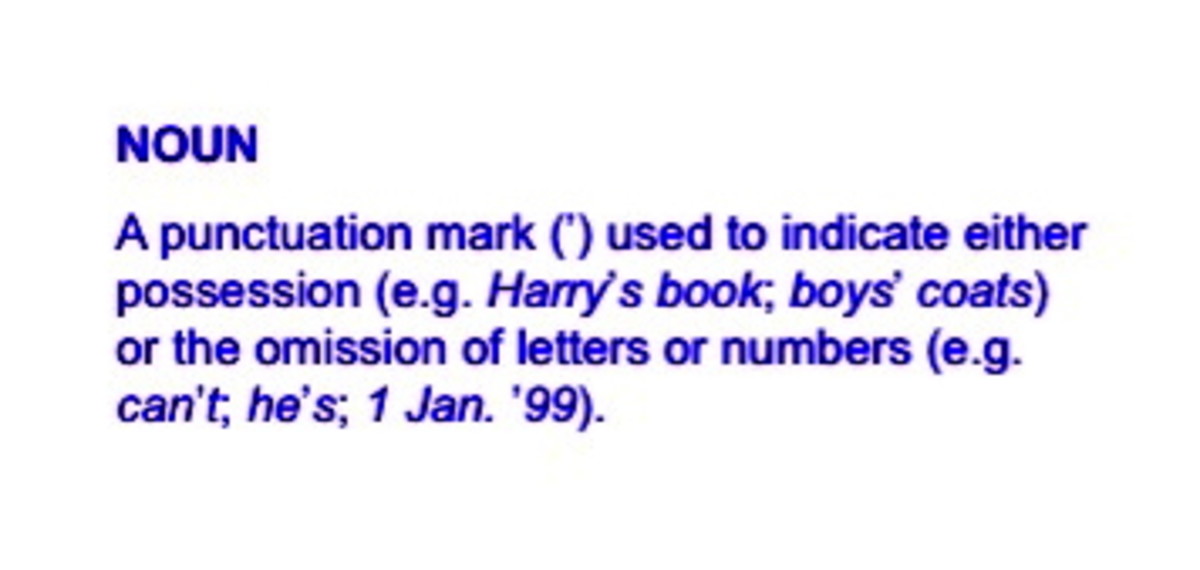
A homophone is a word that sounds like another word (or words) but is spelled differently. When spoken aloud, the hearer knows no difference, but when written the difference is obvious. We will look at five sets of the most commonly misspelled homophones. Four out of the five we review involve apostrophes. Learning how apostrophes are used basically for either contractions or possession should help you to avoid the common errors discussed in this article.
Your vs. You're
Think about what the “re” stands for in “you’re.” The “re” is short for “are,” right? In this case, the apostrophe is used to contract two words together: "you" and "are." On the other hand, “your” is simply a possessive pronoun. I sometimes see written, “Your welcome” instead of “You’re welcome.” Remember that the phrase means that “you are welcome” rather than that you possess a welcome!
Correct Usage Examples:
Your wish is my command. (shows possession)
Do you think you’re going to the game? (contraction: you are)
Their, There, and They're
“They’re” is in the same category as “you’re.” Both words are contractions, a combination of two words. When in doubt, check to see if "they are" makes sense in the sentence. If it does not, then try the other two options.
“Their” is a possessive pronoun, as is “your," which we just looked at.
“There” refers to a place.Think of the places "here" and "there." "There" is "here" with a "t" added to it. Remember it that way.
Let’s look at the correct ways to use each word:
They’re at school right now but will be home later. (contraction: they are)
Have you seen their new car? (shows possession)
I think that the church is over there near the hospital. (location)
Its vs. It's
These two words are perhaps the most commonly miswritten homophones. There are two important things to remember when trying to decide which word to use. First, are you using a contraction of two words? Only if you wish to convey “it is" would you use the contraction “it’s.”
Use “its” without the apostrophe only for possession. But wait? Doesn’t possession require an apostrophe? Well, nouns do require an apostrophe to show possession, as in “the neighbor’s house.” But possessive pronouns are already possessive and do not need an apostrophe. Consider the pronoun we already discussed: “your.” Do we say “you’r dog”? No. We say “your dog” to show possession--without an apostrophe.
Consider the following possessive pronouns: your, his, hers, ours, theirs. Think about how funny they would look with an apostrophe to show possession. You’r purse? Hi's wallet? Or is it hers? Although “its” is, undoubtedly, more confusing because it can be confused with the contraction “it’s,” this possessive pronoun, like the pronoun family it belongs to, also shows possession without the use of the apostrophe.
Correct ways to use “its” vs. “it’s":
The cat licked its tail. (shows possession)
It’s probably going to rain later today. (contraction: It is)
Who's vs. Whose?
The easiest way to remember which word to use in this case is to ask yourself if the word you need is a contraction. Could the word you choose be replaced with “Who is”?
Let’s try it. Fill in the following blank.
____________ going to the game with me?
The correct answer is “Who’s” since “Who’s” could be replaced with “Who is.”
Whose is used when no contraction is needed.
Example: I would like to know whose silly idea this was! Since you couldn’t replace “whose” with “who is” in that sentence, the correct choice is “whose.”
To, Too, and Two
Finally, “to” versus “too.” I include “two” since it also sounds the same, but I rarely see it confused with the other two words. “Two” is simply the number 2. Let’s move on to the more difficult “to” and “too.”
A way to remember when to use “too” is to keep in mind that “too” has an extra “o” in the word. “Too,” then, is used when something is superlative, or “too" much.
Example: I have too much time on my hands. (Note the extra "o," meaning more)
“Too,” with the extra “o,” is used, too, in the same way that "also" is. Both are used when there is something extra, such as in the example: “I would like to go, too," or "I would like to go, also."
“To” is simply a preposition that indicates movement toward something. Remembering that “to” is a part of the word “toward” might be helpful, too, as their meanings are similar.
Correct Usages: Are they going to the meeting? I would like to go, too.
More from the Grammar Geek!
- 10 Commonly Misused Words
This grammar geek hates to hear language used incorrectly. Here are ten commonly misused verbs and other words that I hear on a daily basis. It's my hope that I can teach somebody something that they will use.
Using Homophones in Sentences
I heard that you’re going to the party in your own car. I don’t care whose car I ride in; my car is on its last leg. I don’t know who’s going to be there, either. The hosts sent their invitations early, and I think they’re expecting us to show up by 7:00. It’s 5:30 right now, a little too early to go. I have two parties to go to tonight, too!
September 2011 Grammar Geek
Quiz: Choose the correct answer.
view quiz statistics© 2011 Victoria Lynn